

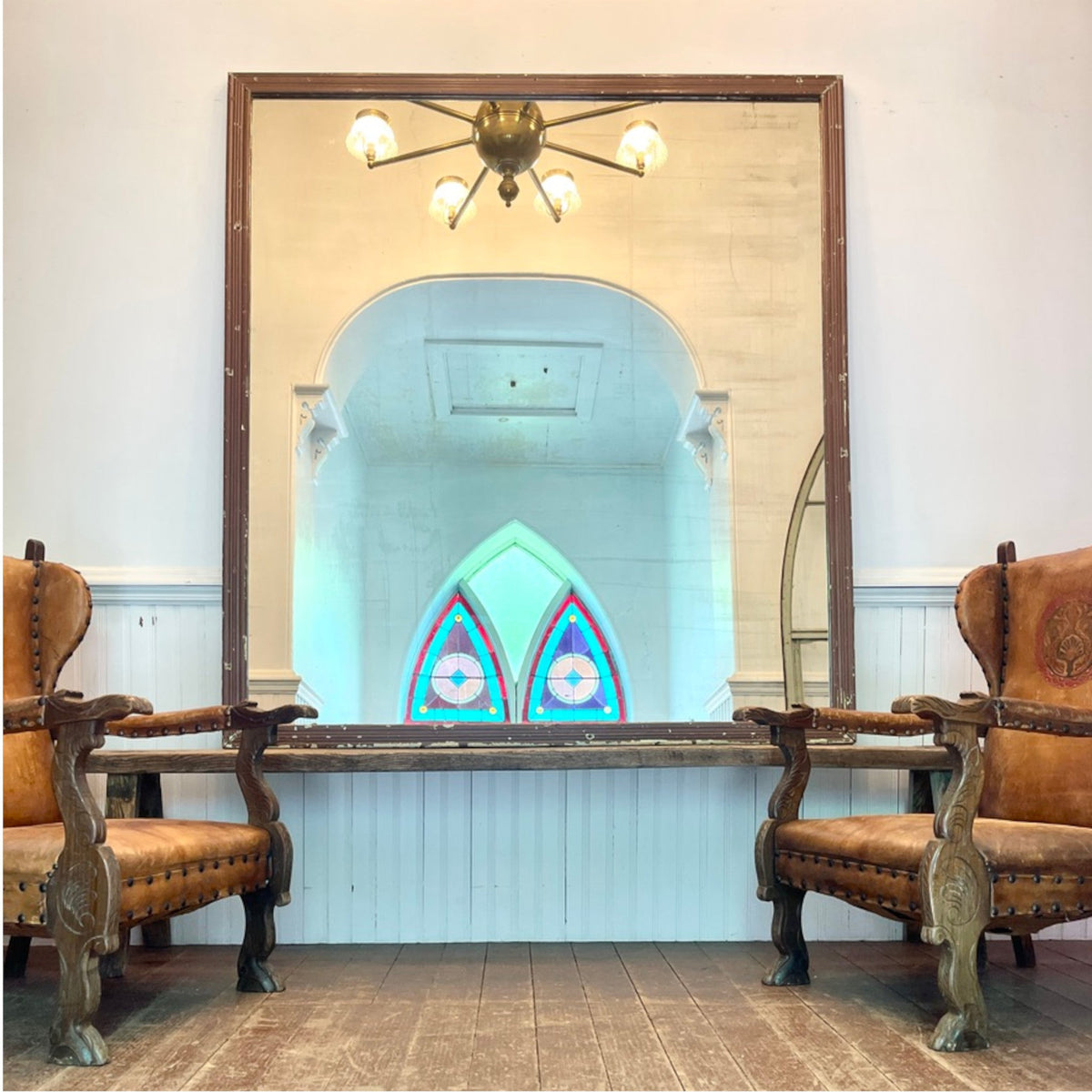
It took two of us to stand the big mirror up, and a certain amount of quiet swearing. Sixty-four and a half inches wide, seventy and a half high, and plate glass of the old thick kind. Once it was against the wall we both stepped back, and then nobody said anything for a while, because the room behind us had gone soft and silver and slightly wrong, in the best possible way.

Here is the thing worth saying out loud. By any modern standard, that mirror has failed. The silvering has broken down across large areas, in clouds and veins and little constellations of loss. The frame is moulded wood under an old painted finish with chips, marks and earlier colours showing through where the paint has gone. Its original setting is unknown to us, and we will not pretend otherwise. If that plate came off a line in a glass factory this morning, it would be scrapped before lunch.
And it is one of the most valuable surfaces in the building. Not in spite of the wear. Because of it.
If you have been reading along, you will know we keep coming back to this. In What a House Remembers it was the memory a building leaves in its materials. In Nobody Is Casting Another One it was the simple fact that when these pieces are gone, they are gone. In The Most Modern Room on the Street it was how an old thing can end up the freshest idea in a house. The question underneath all three is a practical one: of everything in a room, what will be worth more to somebody in forty years than it is to you today?
The test
The test I use is unglamorous. Can you picture two reasonable adults, some years from now, negotiating politely over who gets it? Nobody negotiates over a hollow-core door. People negotiate over doors like these: solid wood, with a century of patina on them.

These came out of a small town in the Ottawa region. Believed to be Douglas fir, six raised horizontal panels each, and here is the part I like: one face still carries most of its rich dark original finish with all the honest wear that goes with it, and the reverse has been stripped back to the warm bare wood. We like both sides, for completely different reasons, which is an awkward thing to admit in a sales listing and entirely true. The original recessed brass pulls are still in place. On the finished side they line up. On the stripped side they are offset from each other, because at some point in a hundred-odd years somebody put one back in the wrong spot. We left it. That offset is the signature of a long life and it is not ours to erase.
What wears out, and what wears in
Most of what we buy for a house is at its best the day it arrives. The cushion flattens, the finish dulls, and the colour that was everywhere three years ago starts to date the room. That is not a failing. Those things are meant to be used up.
A few things go the other way. They arrive already imperfect and then they get better. Wood that has been waxed and knocked and sunned for a century takes on a depth no new finish can copy. Copper goes greener. Old glass goes stranger. Paint wears through to the colour underneath, and there is no shortcut to that. You only get it by waiting.
You can see it all over the showroom. The 19th Century Chinese Painted Tapered Cabinet stands over eighty-two inches high and narrows in both width and depth as it rises, which gives it an almost architectural stance against a wall. Its dark brown and charcoal paint has worn down naturally to traces of blue-green and bare wood beneath. Quieter than the bright red lacquered cabinets people expect, and far harder to find.

Or the Long Rustic Antique Work Table with Splayed Legs, which is eighty-two inches long and only sixteen and a half at its widest. Tool marks, filled openings, softened edges, a top that got that way from decades of somebody working at it. It served as a desk before it came to us. It will serve as a desk again, or as a console behind a sofa, and in either case the surface keeps gaining.
And copper, given time, only goes one way. The 19th Century Copper Sacred Heart Church Cupola Cap was hand formed from heavy sheet copper and held together with hundreds of hand-set rivets. It is believed to have crowned a cupola or roof lantern on a late 19th-century Catholic church, though its exact origin is not known. Its weather is all over it, and it has nowhere to go but deeper.
I am not going to tell you any of this is an investment. We do not promise returns and I would not trust anyone who did. What I will say is simpler: nobody can make these surfaces now, there are fewer of them every year, and unlike nearly everything else you will put in a room, they get better while you own them. That is what permanence actually looks like in a house. Not something frozen. Something cultivated.
Which leaves one question, and it is the one the next essay is about. If you have gone to the trouble of owning something that improves, who do you eventually hand it to?


