

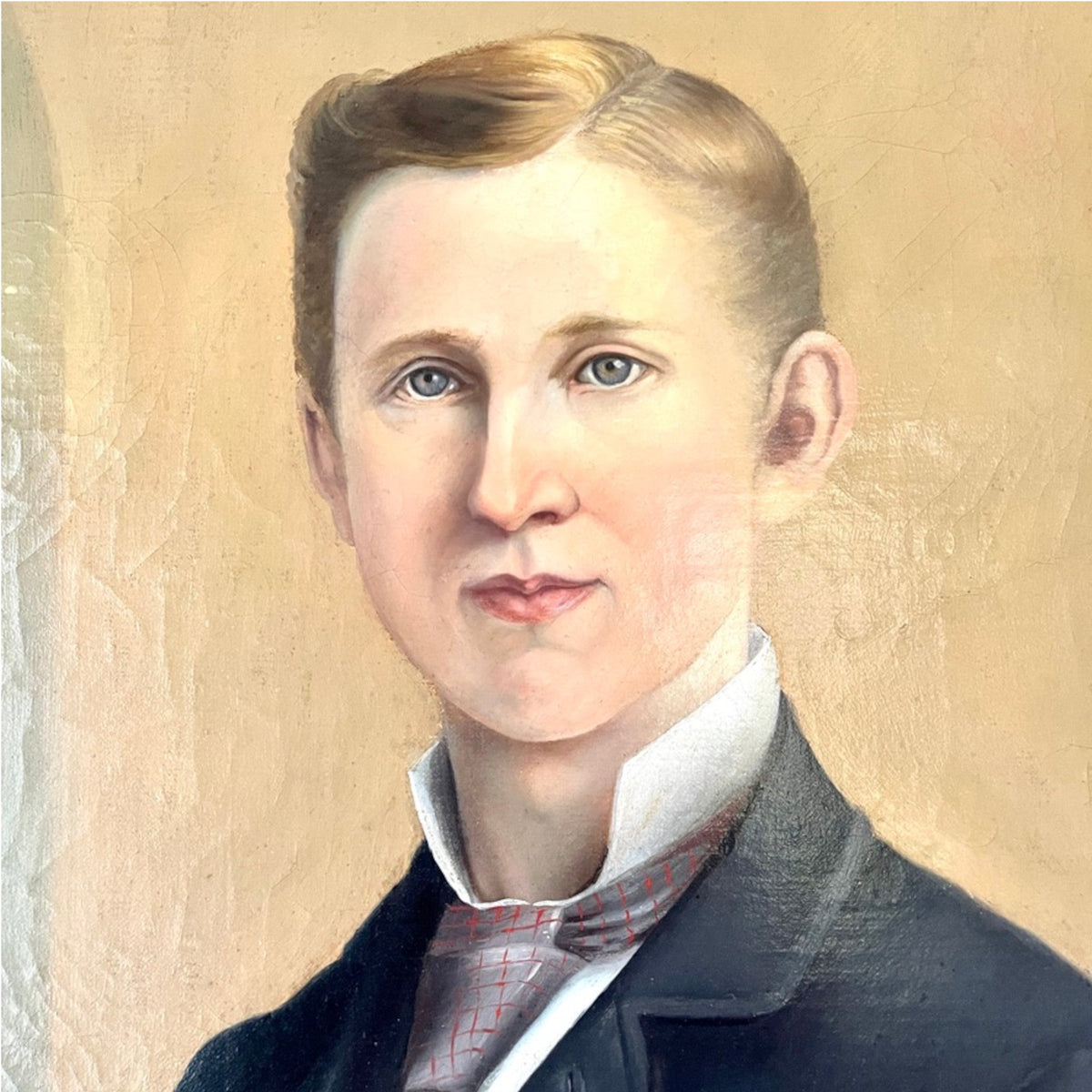
He hangs near the front of the showroom and he watches you come in. Late 19th century, oil on canvas, a young man formally dressed in a dark coat with a high white collar and a tie, painted well enough that you keep glancing back at him while you talk to somebody else.

The details are the interesting part. A gold pocket watch chain. A wedding band. Clothing that has been tailored rather than bought. None of it is shouted. It is the quiet vocabulary of a man doing reasonably well, recorded by somebody he paid to record it, in an era when having your face painted was a considered expense and a statement about the future.
He is unsigned and unidentified. On the reverse of the worn painted frame there is an old handwritten fragment that appears to read Cherry Hill, and that is the whole of what we know. We looked. No further provenance has turned up, and I would rather tell you that plainly than build him a story. The canvas has been re-stretched and carries an honest old patch repair, which tells you somebody, at some point, thought him worth saving.
And then somebody did not. That is the part I turn over. This was a piece commissioned to be inherited. It was meant to hang in a hall and have a name attached to it for three or four generations, and the name came loose somewhere along the way, probably in an afternoon, probably during a clearing-out that felt entirely practical at the time.
He survived anyway. That is the thing about a well-made object: it can outlive its own paperwork and still be worth keeping. He has lost his identity and not one bit of his presence. Put him above a stair, or in a dim library, or deliberately against something very modern, and he does exactly what his sitter paid for. He holds the room.
He will not be yours by blood. He can still be the thing in your house that somebody argues gently over later. That is a perfectly respectable way for an inheritance to begin.
This piece is a companion to The Piece You Pass On, from the Journal.


