

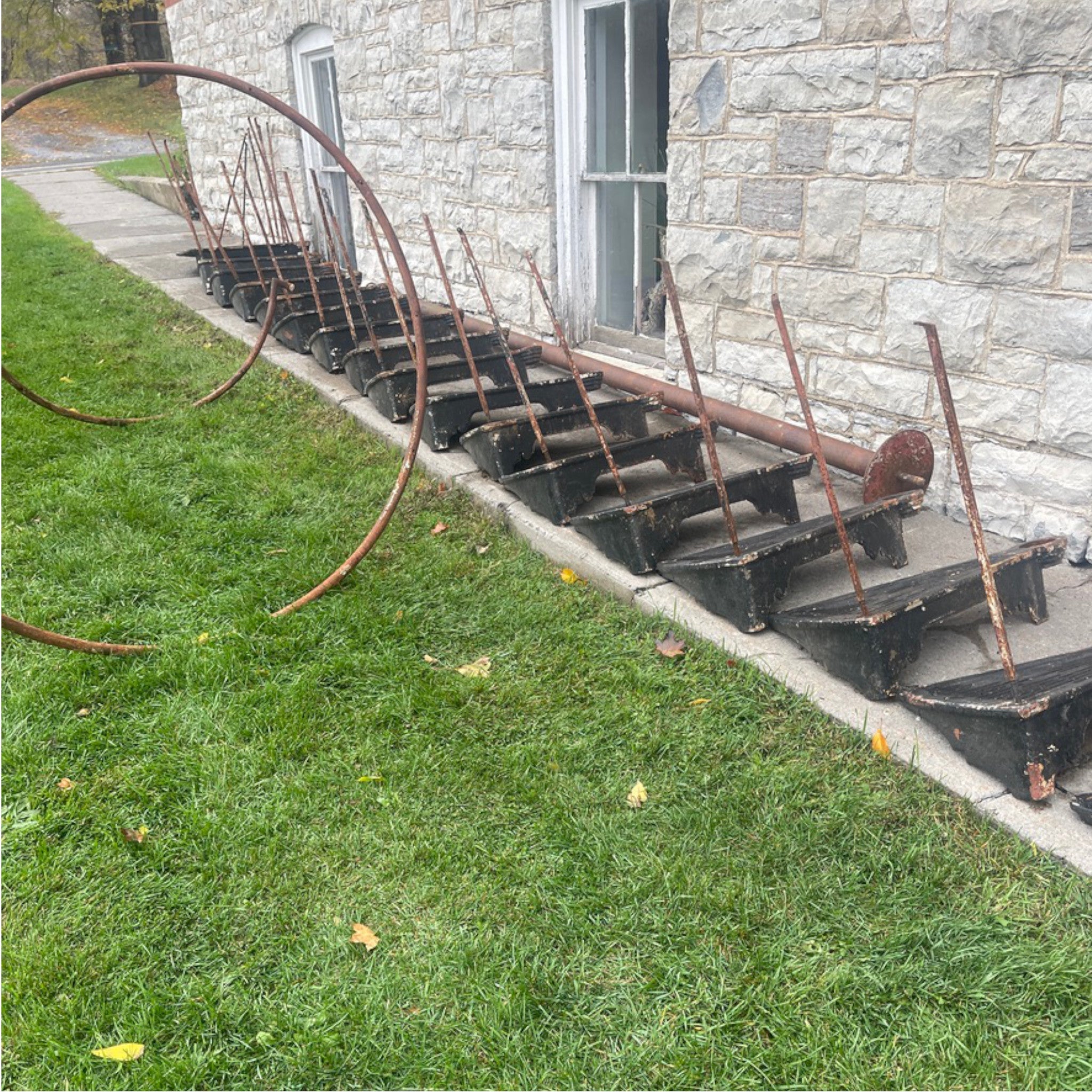
The staircase arrived lying down. Twelve feet of it, taken apart the way spiral stairs have to be, the treads stacked along the stone wall outside the showroom like a set of very heavy playing cards. Each one is a fan of cast ribs, radiating out from the collar that once slid onto the centre column, the ribs there for traction so that nobody in soft shoes ever went down faster than they meant to. Under the black paint there is red paint. Under the red there is more black. Somebody kept that stair looking after for a long time.
It came out of a convent chapel and it went up to the choir loft. Circa 1910. Roughly sixty inches in diameter, twelve feet floor to floor, original centre spindle column, original baluster posts, the curved railing sections still with it. Industrial casting doing an ecclesiastical job, which is a combination you only really get in that thirty or forty year window when foundries could make something both cheap to produce and genuinely beautiful.
Here is the thing I keep coming back to, and it is the whole of this essay in one line: the chapel had one.

Scarcity you cannot manufacture
Most scarcity you meet in a day is a decision somebody made in a meeting. Limited run. Numbered edition. Two hundred made, and then, some months later, two hundred more in a different colour. There is machinery behind it, and the machinery can always be started again.
Salvage has no machinery. The count was set decades ago by a building, by people who were not thinking about us and had no reason to. One stair to the choir loft. One set of gates across the chancel. One transom over the front door of the general store. When the building comes down, what we get out of it is the entire supply, permanently. There is no back room. There is no second one in the basement. That is not a sales position, it is arithmetic, and it would be equally true if we never sold a thing.
Matched sets are where the arithmetic gets interesting. We have ten tall leaded glass windows out of an Ottawa-area residence, diamond quarry pattern, original lead caming and clear glass, all ten uniform in size, no visible cracks, only light flecking on the painted frames. The latches came with them. The hinges and closers were removed during the salvage and are not there. Ten windows that agree with each other completely, because a century ago someone ordered them at once and a glazier made them at once and one house held them together ever since.

You can find a single leaded window most months of the year. Ten that match is a different object entirely, and it is fragile in a way the glass is not. Split that set among four people and it stops existing. Four buyers get four nice windows. Nobody gets the run of ten down a hallway, which was the only reason the set was worth keeping whole.
The monumental ones
Then there are the pieces that were never going to have a twin. A set of ecclesiastical wrought iron gates, 141 inches long by 101 high, two fixed side panels and two narrow working gates, built in the chapel screen tradition: lyre scrolls, heart motifs, twisted uprights, tight hand hammered collars. Late nineteenth to early twentieth century. Rich aged patina with small areas of loss, which we photograph rather than describe around.

Or the tombstone windows from a mid nineteenth century general store in Eastern Ontario. Two tall sidelights meant to flank the entrance, four big arched storefront windows, original wavy glass still in them. The lower portions need significant restoration and we say so, because a piece like that is a project and pretending otherwise helps nobody.
And sometimes the honest answer is that we do not know. We have a hand formed copper cap, heavy sheet copper, hundreds of hand set rivets, crowned with a Sacred Heart beneath a Latin cross, believed to have topped a cupola or roof lantern on a late nineteenth century Catholic church. Exact origin unknown. We could invent something. It would sound wonderful. It would also be worthless, because the only thing that makes provenance valuable is that it is true. Our pair of monumental cast iron urns on plinths, eighty one and a half inches of them, are likely late twentieth century work using traditional casting methods. That is what the casting tells us and that is what we will tell you.
What this asks of you, which is not much
Nothing here comes with a countdown. We will never phone you to say the price goes up Friday. What we will do is tell you plainly what a piece is, what condition it is in, and how many exist, which in most cases is one. What you do with that is genuinely yours. Some people measure twice, live with the photographs for a month, and buy. Some people wait, and the piece goes to Vancouver or Vermont, and that is fine too. We deliver into Toronto, Ottawa and Montreal ourselves, and we crate for everywhere else, across the country and down into the States. Things leave here for houses we will never stand in.
But the math is worth knowing. The stair went up to a loft where people sang, and it is not going back, and nobody is casting another one.
Which raises the next question, and it is the better one. It is not only that these pieces are few. It is how they were made, and why that particular hand cannot be hired again at any price. That is where we are going next.


