

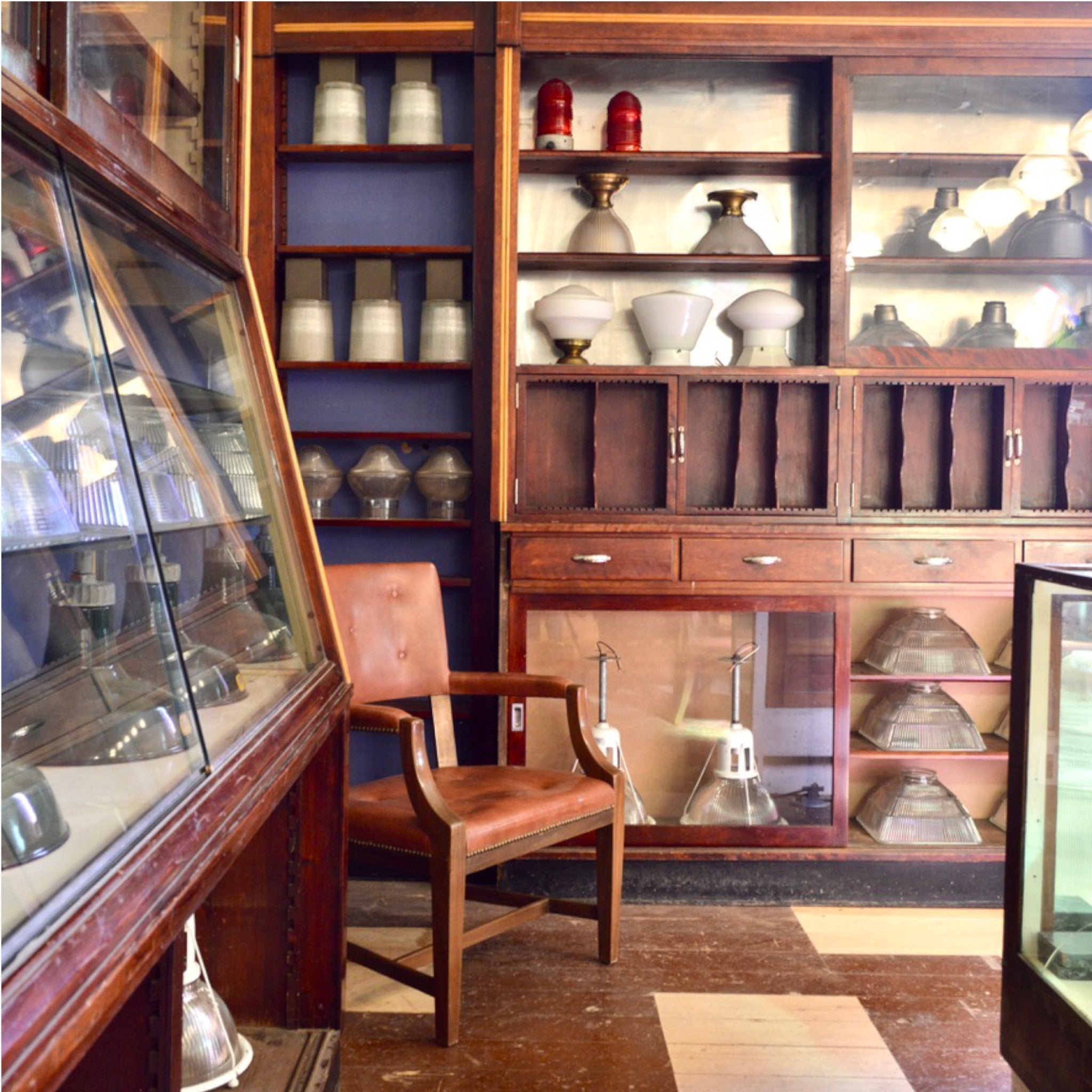
In the years between the wars, a druggist in Perth, Ontario did something a small-town shopkeeper was not expected to do.
He spent real money on the way his store looked.
Not on stock. On cabinetry - forty-six feet of it, built to line the walls of Thornbury's Drug Store. And he didn't order the heavy, carved, Victorian apothecary look his father's generation would have expected.
He ordered the newest thing: clean, flat, restrained, architectural. No turned columns, no fussy carving. The kind of cabinetry a great department store would commission. He wanted his shop, on a small-town main street, to look as good as the best in the big cities.

But it wasn't only for show. It was built to work.
The upper cabinets slide on glass - not for looks, but because sliding doors kept the dust off the stock, let him reach what he needed fast, and saved precious clearance in a narrow shop. The angled cases below are set to the height of a customer's eye; they would have held the cosmetics, the perfumes, the shaving goods and patent medicines - the small bright things that made a drugstore feel like an apothecary. The shelving moved as the shop's needs moved. Everything considered. Everything answering to a single idea of what a fine store should be.
That is the part people miss. The restraint we read as tasteful today wasn't restraint for its own sake. It was the latest style, chosen on purpose - and it was engineered. Beautiful because it was well made, and well made because it had a job.

It's also why it hasn't dated. Ornament belongs to its moment; when the fashion passes, it looks old. Strip a thing back to proportion and rhythm and quality - flat faces, clean glass, a single line carried the length of a wall - and there's nothing left to go out of style. It would sit as easily today in a gallery, a modern kitchen, or a luxury shopfront as it did on a main street a lifetime ago.
The shop is closed now. Thornbury's is gone. Forty-six feet of it survived - still a system, still one continuous run, still the cleanest thing in any room you put it in.
He wanted his shop to look like it mattered. It still does.


