

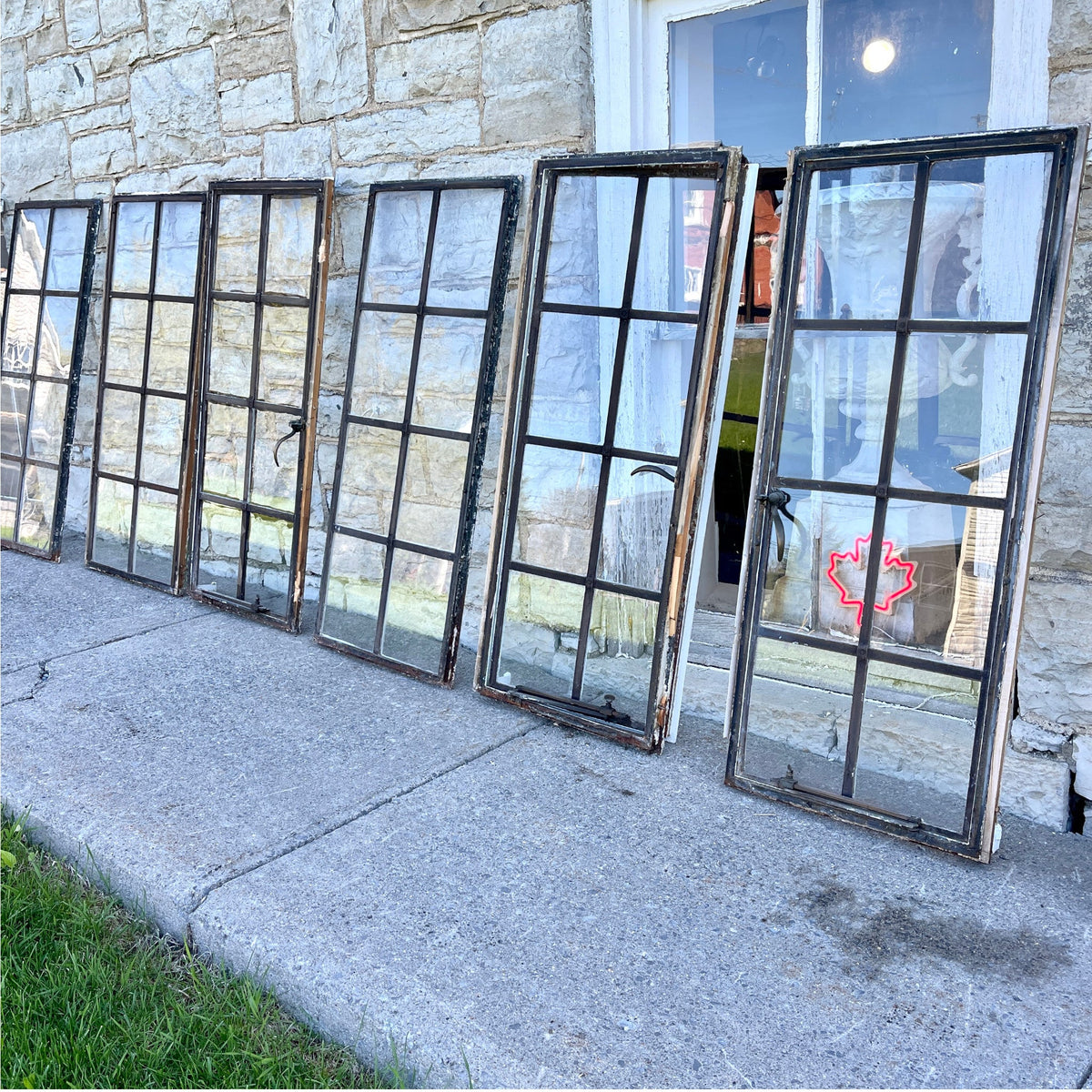
The windows came out of a house in Southern Ontario that was built in 1923. Thirty of them, matching. Somebody, at some point, decided they were coming out. Somebody else decided they were coming out carefully, and that second decision is the one this whole trade rests on. One approach fills a bin. The other fills a truck with a hundred years of rolled steel that still works.
They are Hope's, which will mean something to a certain kind of reader and nothing at all to everyone else. Hope's is still one of the most respected steel window makers in North America, and these early examples have the impossibly slender sight lines the name is known for. The group is a mix of fixed and operable, and the operable ones still carry their original bronze handles, closers and operating hardware. What surprises people is how light they are, visually. Later industrial sash got heavier and blunter. These early 1920s Hope's windows are more architectural than industrial, more drawn than welded.

Here is the plain arithmetic. Every ounce of energy required to make those thirty windows was spent in the early 1920s. The ore was mined, the steel was rolled, the frames were assembled, the hardware was cast, and all of that is finished business. Nothing further is owed. To make thirty new windows of comparable quality, you would start the whole ledger over, and you would not end up with better windows. You would end up with newer ones.
That is the ethic, and people nod along to it politely. But the reason reuse actually wins arguments in real rooms is that it is also the aesthetic. The market has spent twenty years trying to manufacture what age does for free. New steel-look windows. Pre-distressed finishes. Wire-brushed oak sold as reclaimed. All of it is a costume, and a costume is an opinion about how something looked. The original is not an opinion. It is simply the thing. When we wrote about the most modern room on the street, this was the mechanism underneath it: old material reads as calm because it has nothing to prove.
Take the pair of six-panel pocket doors that came to us from a small town in the Ottawa region. Believed to be Douglas fir, six raised horizontal panels each, enormous. One face still holds most of its rich dark original finish with all the wear that came with it. The reverse has been stripped back to the warm wood beneath. We like both sides, for completely different reasons, which is an annoying thing for a shopkeeper to say and entirely true.

The detail I keep pointing at is the hardware. The original recessed brass pocket-door pulls are still in place. On the finished side they line up. On the stripped side they are offset from one another, slightly. Someone was working quickly, or working around something, a very long time ago. We left it exactly as we found it, because no reproduction would ever make that mistake, and the mistake is the proof. It is the same point I was making in Nobody Is Casting Another One, only from the other direction: craft leaves fingerprints, and reuse is how you get to keep them.
Reuse does not mean restoration, either. It does not require a piece to go back to the job it was born into. Architectural Salvage Installation No. 1 pairs an antique timber hayloft door with a nine-lite industrial steel factory window, two things that never met in their working lives and look like they were made for each other now. Hand-hewn wood and honest rust. We could have sold them separately. Composing them felt more truthful about what salvage actually is, which is not preservation in amber but material handed forward to do new work.

The clearest case for leaving well alone is the monumental antique plate glass mirror, sixty-four and a half inches wide by seventy and a half high, with exceptionally thick, heavy glass and extensive age-related deterioration to the original silvering. It is soft, layered, cloudy in places. It cannot be replicated in new glass, and anyone selling you a chemically aged version is selling you the idea of it. We left both the frame and the plate as found. Its original setting is unknown and we are not going to invent one. What it did for a century is unrecorded. What it does in a room is immediately obvious.

So: the greenest material on the market already exists, and it happens to be the most characterful material on the market too. That is a rare case of the right thing and the good-looking thing being the same thing. But notice what a second life quietly assumes. It assumes there was a first, and it assumes somebody will be around to give the thing a third. Which is where what a house remembers starts to matter in practical terms, and where I want to go next. If we are going to hand things forward, we should talk about what makes a thing last a hundred years in the first place.


