

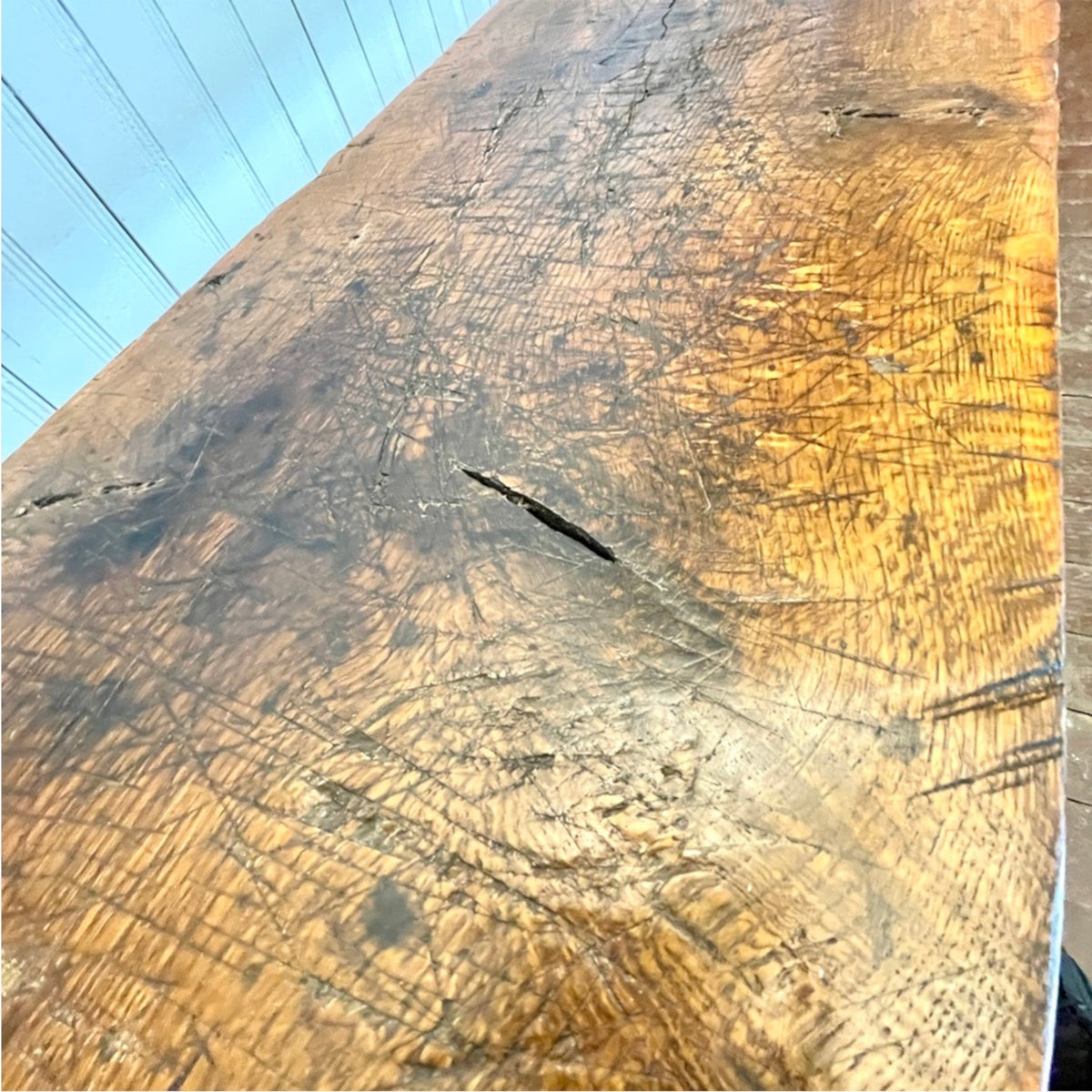
It takes two of us to move the long primitive bench, and we have moved it more than once. One hundred and sixteen and a half inches of timber. A seat plank a full two inches thick. Splayed trestle legs joined with through-tenons, each one locked with a hand-cut wedge you can still see from above. Nobody hid those wedges. They sit right there in the surface where a maker could tap them tighter when the joint eventually loosened, because he assumed it would loosen, because he assumed the thing would be sat on for a very long time by a lot of people.

That is the argument, and I have given it away in the first paragraph. These pieces are beautiful because they were made to work. Not decorated into beauty. Not styled into it. They earned it on the job, and the job is the reason they are still here.
In What a House Remembers we wrote about the marks a building keeps. In Nobody Is Casting Another One we made the case that the supply of this material is finite and closed. Both of those circle the same unanswered question, which is why. Why did these particular objects survive when so much else from the same decades did not? The honest answer is unglamorous. They were built by people who expected them to be leaned on, loaded up, slammed shut and worked hard every day for decades, and so they were built with a margin of strength that furniture made for a showroom photograph does not have.
Take the long rustic work table with splayed legs. Eighty-two inches long and only sixteen and a half inches at its widest point, which is a strange set of numbers until you understand that width was never the point. Someone needed a surface to work along, not to spread out on. The plank top carries old tool marks, filled openings and edges worn soft by hands and sleeves. It has been used as a desk. At twenty-nine inches high it has the presence of a full table and asks for almost no floor, which makes it the rare antique that solves a modern problem: behind a sofa, down a hallway, along a wall in a room that has no spare metre anywhere.

Working does not have to mean rough. Some of the most disciplined craftsmanship we handle came out of commerce. The pair of Kent-McClain mahogany display showcases were manufactured in Toronto by one of Canada's leading early twentieth-century showcase makers, and they came out of the Pequegnat Clock Shop in Guelph. How they travelled from there to here, we cannot tell you. Mahogany cabinets, heavy plate glass vitrines, built to commercial standards because a shop counter takes more abuse in a year than a dining table takes in ten. And look at how restrained they are. That restraint is not shyness. Their entire job was to disappear so the merchandise could be seen. A cabinetmaker who can make something that good and then make it recede is a cabinetmaker with nothing left to prove. That the design sits right on the turn from late Art Deco into the emerging Modern is a bonus. It is why a pair of shop fittings from the 1930s reads as contemporary in a room built last year.

Work also leaves records, and I have come to think the records are the best part. The pair of six-panel Douglas fir pocket doors came from a small town in the Ottawa region. One face keeps its rich dark original finish with years of authentic wear. The reverse has been stripped back to warm bare wood. We like both sides, for entirely different reasons. The original recessed brass pulls are still in place, and here is the detail I cannot stop pointing out to people: on the finished side they line up, and on the stripped side they are offset from one another. Somebody, at some point, set one a little high. A small slip from one ordinary day of work a hundred years ago, still sitting there in the brass. We have left it exactly as we found it.

Two more, quickly, because they make the point from opposite ends. Architectural Salvage Installation No. 1 pairs a hand-hewn timber hayloft door, cast iron rollers and all, with a nine-lite industrial steel factory window. Neither was ever meant to be looked at. A hayloft door exists to keep weather off feed. A factory window exists to get daylight onto a bench. Put them side by side and you get a pairing nobody set out to compose. Each was solving a problem rather than making a picture, and that is exactly why the two of them work together in a room. And the collection of four late nineteenth-century letterpress sorting trays, which I will come back to another day, were custom made in graduated sizes for one shop, by one hand, to suit one workflow.
Here is why this belongs in a real room rather than behind rope. A piece made to work has already survived its hardest years. The dents are in it. The finish has stopped being precious. You cannot ruin the bench by putting boots and a wet bag on it, because boots and wet bags are what made it look like that. Everything new in a house is at its best on day one and declines from there. These things went the other way, and they are still going.
Which raises the next question, and it is the one I want to take up next time: if the thing has already survived its first job, what is its second one?


