

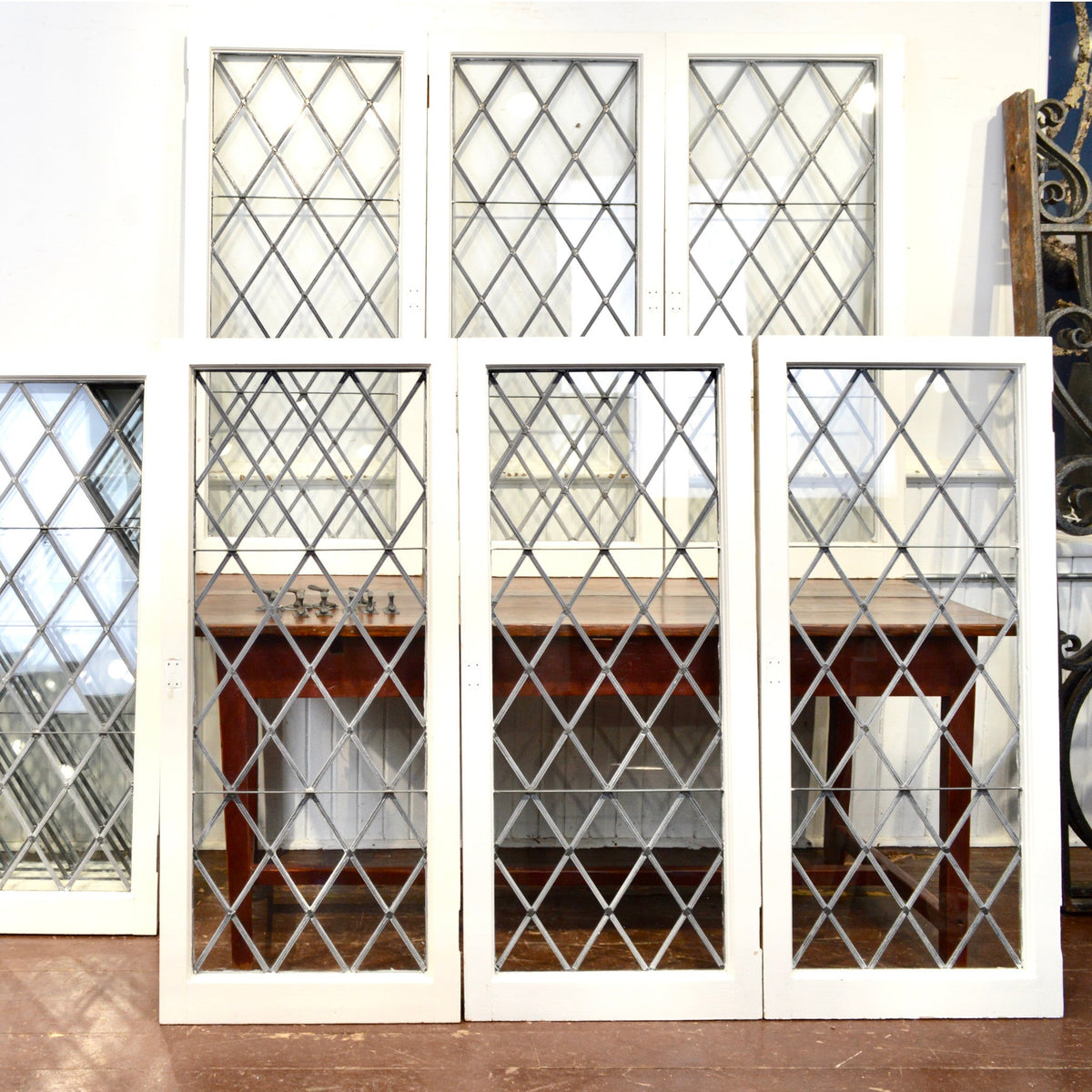
Somewhere in Ottawa, early in the last century, a person stood in a half built house and made one decision about glass. Diamond quarry pattern, clear glass, lead caming, and enough of them to do the job properly. The glazier filled the order in a single run. That is why, a hundred years later, all ten of these windows still agree with one another.

They are tall, uniform in size, and they present beautifully. No visible cracks or breaks anywhere in the set. Surface wear is minimal, with only light flecking to the painted frames. The latches came through the salvage and are included. The hinges and closers did not; they were removed on site and are not present, which is worth knowing before you plan anything that needs to swing.

Ten is the number that matters. A single leaded window is a lovely thing and turns up often enough. A matched set of ten is a different animal, because a set is not really ten objects, it is one object that happens to have ten parts. It came out of the house whole and it can be installed somewhere else whole. Once it is divided, it is gone as a set forever, and no amount of hunting reassembles it. The lead work, the proportion, the exact rhythm of the diamonds, all of it was decided once by one hand.
What they want is interior work. Set into a wall between a kitchen and a dining room, they borrow light without giving up separation. Run in a row, they make a pantry or a mudroom feel like it was always there. Built into cabinetry, they turn ordinary storage into something with a view. As a room divider they do the thing modern glass partitions try to do and never quite manage, which is to look like a decision somebody made rather than a product somebody ordered.
The clean geometry is the reason they travel so well across styles. A diamond quarry pattern is roughly as old as glazing itself and it has never once looked fussy. It sits comfortably in a century home under restoration and it sits just as comfortably in a new build with flat white walls and no other ornament at all, where it becomes the only piece in the room with a hundred years behind it.
We would love to see all ten go together. That is the version where the original decision survives, one more time, in a house that has not been built yet.
This piece is a companion to Nobody Is Casting Another One, from the Journal.


