

A window has one job. Everyone knows it. It sits in a wall and lets the light through.
Take the wall away.
What’s left is not really a window anymore. It’s a structure - a grid of steel, a rhythm of panes, a frame that organizes whatever stands behind it. A salvaged factory window was built to do hard work for a century, made heavy and square and honest long before anyone thought of it as beautiful. Lift it out of the wall and that strength becomes something else entirely.
It becomes architecture you can stand in a garden.

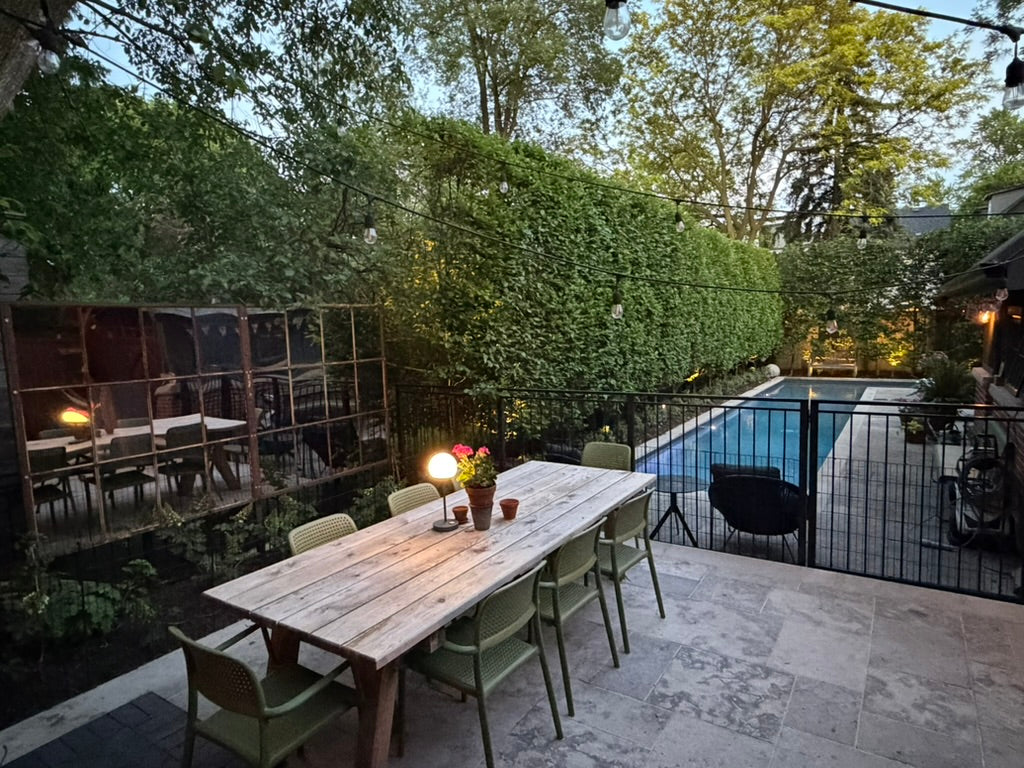
In one Toronto garden, that is exactly what happened. A run of salvaged steel windows stands free beside the dining area - not against anything, not filling a gap. A screen. But instead of glass, there’s mirror set into the frame.
That single decision is the whole thing.
A mirror doesn’t close a space. It opens it. The garden arrives at the screen and keeps going - the planting doubles, the sightline runs twice as far, the table sits in a room that suddenly has more depth than the lot ever gave it. A solid fence would have ended the garden there. The mirrored window sends it back on itself.
You stop reading the windows as windows. You start reading the space they made.

That is the move worth noticing. Not the salvage. The rooms.
Because this is what the garden actually is: a series of outdoor rooms. A place to eat. A place to sit by the water. A threshold between the two. Each one defined, each with edges and a centre and a reason to be where it is. The windows are one of the tools used to draw those lines - a striking one, but a tool.
We made the same point here last month, about urns and gates and fence panels: a garden becomes a room when something decides its shape. This is that idea, built. The anchors came first. The garden settled around them.

This project was designed and executed by the team at Earth Inc., a Toronto-based landscape design-build firm known for creating highly detailed outdoor environments that balance architecture, planting, and craftsmanship. The way a garden like this holds together - from the first step to the last - is their work.
The salvaged steel factory windows were sourced through us at Salvage Garden and adapted by the Earth Inc. team as mirrored garden screens.
That is the honest division of labour. We find the piece. Someone with an eye decides what it could become.
And that is the part that is hard to buy off a shelf.

A salvaged window is only a salvaged window until someone looks at it and sees a way to stretch a sightline, mark a threshold, throw the evening light back across the water. The material is old. The thinking is not. What separates a designed garden from a handsome collection of objects is rarely the objects. It is the decision about what they are for.
You can see it best at dusk. The lights come on, the mirrors catch them, the planting goes soft, and the whole space reads as one composed thing rather than a yard with good pieces in it.
That is not what the window cost.
That is what the design did.
But it started with the window. It always does.
Garden design and build: Earth Inc., Toronto. More of their work on Instagram and Facebook.


